A 3 side seal pouch is one of the simplest and most widely used flexible packaging formats, made by sealing a laminated film on three edges and leaving one end open for filling. Because it protects products well, prints cleanly and runs on a wide range of filling and bag-making equipment, it serves food, pharmaceutical, agricultural and industrial customers alike.
This article explains how the pouch is built, which film structures suit which products and what to consider when ordering, so you can choose the right pack for your business.
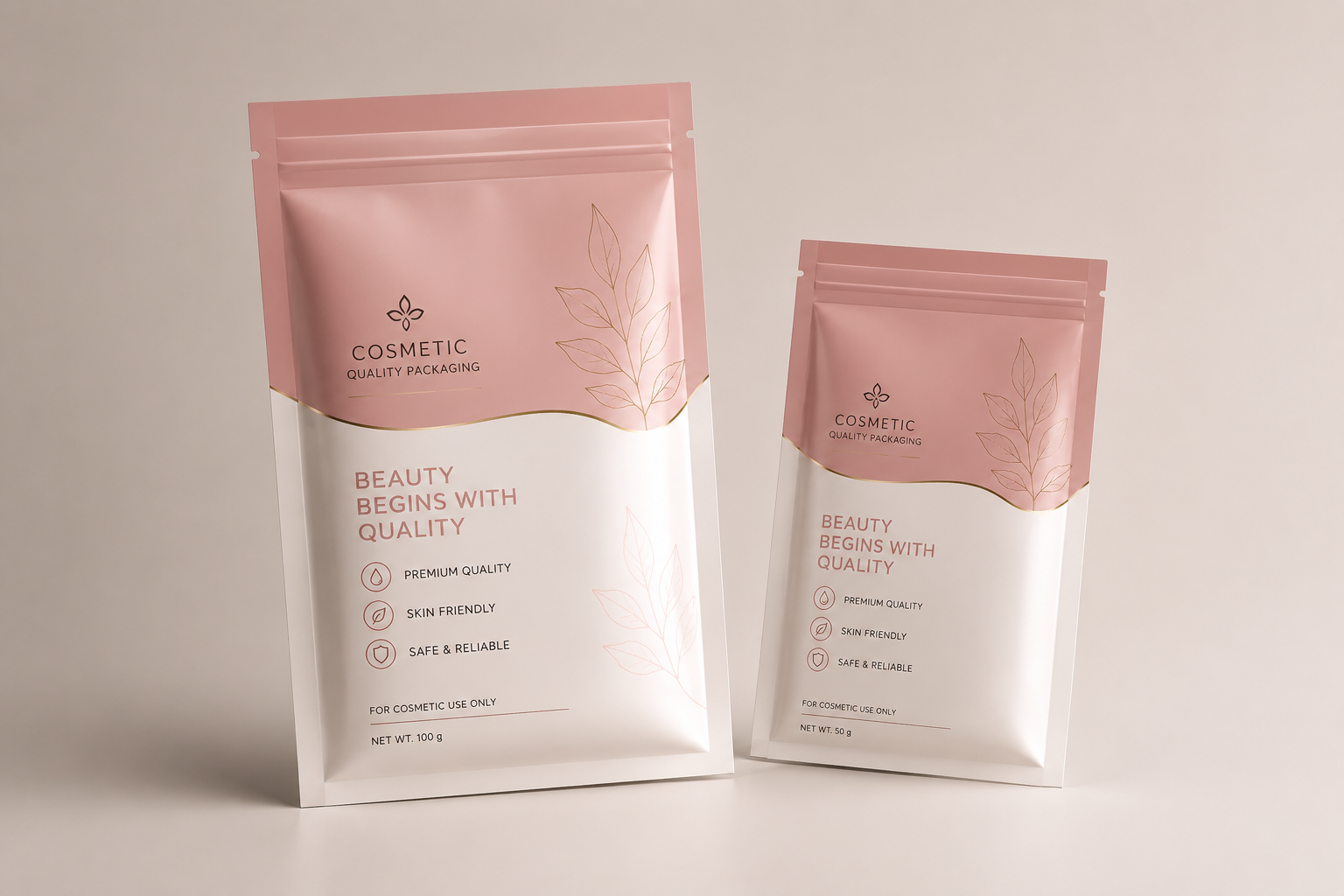
1. What is a 3 side seal pouch and how is it built?
A 3 side seal pouch is sealed along two side edges and the bottom, with the top left open so the product can be filled and then sealed. It is made from two flat panels of film, usually a multi-layer laminate, which means the pouch has no gusset and lies flat when empty. This simple construction is why the format is easy to produce, easy to store and easy to fill.
In a typical laminate, the outer layer carries the print, one or more middle layers provide barrier against gas, moisture and light, and the inner layer forms the heat seal and contacts the product. Stavian describes its three-side pouch as a multi-layer laminate with good preservation, airtightness, moisture and oxidation resistance, and a professional appearance. Pouches can be supplied in two-layer or three-layer constructions, so the structure can be matched to the product rather than fixed in advance.
2. Key advantages of a 3 side seal pouch
The first advantage is flexibility. Pouch size, print design and film structure can all be customized, so one format can serve very different products. The second is print quality: the flat surface supports sharp, durable printing, and Stavian notes that the ink stays on the film without scratching. The third is mechanical strength, since a laminated film resists tearing and puncture better than a single thin layer.
Another advantage is compatibility with automation. Three-side-seal pouches can be made on dedicated bag-making lines, and in vacuum packaging the format is described as suitable for automatic vacuum machines and stable under deep vacuum. The format is also economical. It typically uses less film than gusseted or stand-up designs, and because the structure is flat, it is easy to pack, ship and store in volume. The trade-off is that the pouch does not stand on its own, so it is better suited to products that are displayed hanging, boxed or sold in flat packs than to those that need to stand on a shelf.
3. Film structures for a 3 side seal pouch
The right structure depends on how much protection the product needs. For general food and consumer goods, a two-layer PET/PE laminate of about 70–90 µm is an economical choice. Dry goods and spices often use PET/CPP at about 60–80 µm. For snacks and confectionery, OPP/CPP at 40–60 µm or OPP/MCPP at 45–55 µm gives a clear or light-blocking pack that runs well on automatic equipment.
For enhanced barrier properties, a three-layer structure is typically used. A PET/MPET/PE combination at 80–110 µm offers medium barrier suitable for coffee and snacks, while PET/AL/PE provides a high barrier for coffee and pharmaceuticals at the same thickness. For high barrier options without metal, a PET/SiOxPET/PE layer at 60–90 µm is ideal for cosmetics and food.
4. Applications of a 3 side seal pouch across industries
According to Stavian, this format is a popular choice for food, pharmaceuticals, powders, nuts and seeds, coffee, tea and dry food. In food, snack, confectionery and dry-goods producers use it for its barrier and print quality, while coffee and tea packers choose structures with metallized or foil layers to keep aroma in and oxygen out.
The same construction works well beyond food. Pharmaceutical and personal-care products rely on the pouch for moisture and light protection, and small sachets for agricultural chemicals are a familiar example of the format. Electronic components can be packed in an antistatic PET/MPET/PE structure of about 80–100 µm.
Whatever the industry, the useful question is what the product needs protection from, whether that is oxygen, moisture, light, oil or physical damage, and then which structure delivers that protection at the lowest practical cost.
5. How to choose and order a 3 side seal pouch
Start by giving your supplier the product type, fill weight, required shelf life, filling method and artwork. These details let the supplier recommend a film structure, thickness and pouch dimensions. As a reference, a three-side-seal bag-making line described in Stavian’s training materials runs at up to 200 cycles per minute and handles pouch widths of 78–600 mm and lengths of 50–300 mm.
For layout and printing, the printing film width is the total width of the printed items plus a 20 mm margin. For this format, the lay-flat width equals the pouch width multiplied by two faces, and the cut length is the pouch height arranged around the circumference of the printing cylinder. Getting these numbers right early reduces waste and avoids expensive changes to printing cylinders. If you need to reclose the pouch after opening, ask about the zipper 3 side seal pouch version.
6. 3 side seal pouch and the move toward recyclable packaging
Sustainability is reshaping flexible packaging design. According to Extrusion magazine, RKW Group and SAES Coated Films have developed a high-barrier PE film designed for recyclability, and their first customers have already produced recyclable mono-material pouches, including pouches with zippers. The base is an MDO-PE film that can replace stiff films such as polyester or nylon normally laminated with PE.
For a 3 side seal pouch, this means mono-material PE structures are becoming a realistic option for products with moderate barrier needs, while highly sensitive products may still need conventional laminates. If recyclability is a goal for your brand, discuss it with your supplier early, together with your shelf-life requirement, so both can be balanced in the structure you choose.
7. 3 side seal pouch at Stavian Flexible Packaging – A comprehensive and reliable packaging partner
Stavian Flexible Packaging, a member of Stavian Group, supplies high-quality packaging solutions for domestic and export markets. Its production follows strict quality management standards and holds international certifications including ISO 14001:2015, ISO 9001:2015, GRS, REACH Compliance, FDA Compliant and KIWA. With 06 factories and an output of 50,000+ tonnes per year, Stavian Flexible Packaging is committed to delivering products and services of leading quality to customers at home and abroad.
To learn more about specifications or to request advice and samples, visit the 3 side seal pouch product page, or browse the full range at https://stavianpackaging.com/products/
