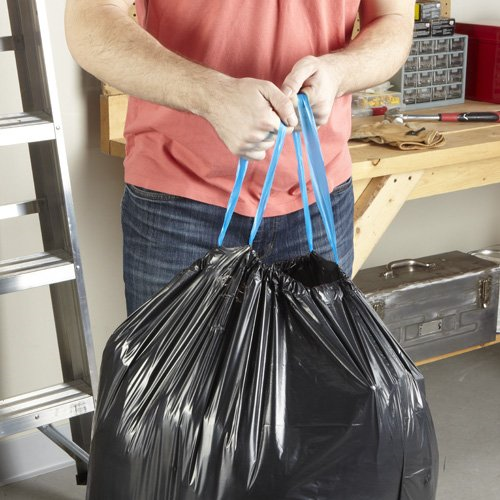
Drawstring trash bags are widely used in homes, offices, restaurants, and commercial facilities because they are convenient, durable, and easy to close. Unlike conventional garbage bags, they feature an integrated drawstring that allows users to secure waste quickly and carry the bag more easily. Behind this practical design is a manufacturing process that combines suitable materials, precise film extrusion, bag forming, and strict quality control.
Understanding how drawstring trash bags are made helps businesses choose reliable packaging products that meet their performance and usage requirements.
1. Materials used in drawstring trash bags
The manufacturing process begins with selecting the right raw materials. Polyethylene (PE) is commonly used because it offers flexibility, moisture resistance, and good processing properties.
The main materials include:
-LLDPE (Linear Low-Density Polyethylene): Provides flexibility, tensile strength, and resistance to tearing and puncturing.
-LDPE (Low-Density Polyethylene): Improves softness, flexibility, and ease of processing.
-HDPE (High-Density Polyethylene): Offers stiffness and strength at relatively low film thickness.
Color masterbatch and additives: Used to achieve the required color and specific product characteristics.
Manufacturers may blend different PE grades to balance strength, flexibility, thickness, and cost. The drawstring material must also be compatible with the bag design to ensure reliable closure and carrying performance.
2. The manufacturing process

Producing drawstring trash bags involves several key stages, from raw material preparation to finished-product inspection.
Step 1: Raw Material Mixing
PE resin pellets are mixed with selected masterbatches and additives according to the product specification. Accurate formulation helps maintain consistent color, processing performance, and finished-film properties.
Step 2: Blown Film Extrusion
The prepared materials are fed into an extruder, where heat and mechanical force melt the resin. The molten plastic passes through a circular die to form a continuous tube. Air inflates the tube into a bubble, allowing the film to expand and cool.
The resulting film is flattened and wound into rolls. During this stage, manufacturers control film thickness, width, and cooling conditions to achieve the required strength and uniformity.
Step 3: Bag Forming and Drawstring Integration
The film rolls are transferred to bag-making equipment. The upper edges are folded and heat-sealed to create channels, or hems, that hold the drawstring. Depending on the design, the drawstring may be integrated into the bag structure or produced separately and inserted during conversion.
The machine then cuts the film to the required length and seals the appropriate edges to form individual bags. Precise sealing is essential to prevent leakage and premature tearing during use.
Step 4: Perforation and Roll Formation
After the bags are formed, perforations may be added between individual bags so users can tear them off easily. The bags are then arranged into rolls or other packaging formats according to customer requirements.
Step 5: Packaging and Final Inspection
Finished drawstring trash bags are counted, packed, labeled, and prepared for shipment. Before packaging, samples are inspected to confirm that they meet the specified product requirements.
3. Quality control: Ensuring reliable performance

Quality control is essential to ensure that every bag performs as expected. Manufacturers typically evaluate several important characteristics:
-Film thickness and dimensions: Ensure consistency with product specifications.
-Tensile and tear resistance: Help the bag withstand the weight and handling of waste.
-Seal strength: Prevents the bottom or side seams from opening during use.
-Drawstring functionality: Ensures the closure can be pulled, tightened, and secured without breaking easily.
-Visual appearance: Checks for holes, uneven thickness, contamination, and other visible defects.
Testing methods and acceptance criteria should be established according to the intended application and customer requirements. Consistent inspection helps reduce product defects and improve customer satisfaction.
4. Choosing a reliable manufacturing partner
High-quality trash bags depend on more than raw materials alone. They require appropriate manufacturing technology, controlled production conditions, and a systematic approach to quality management.
Stavian Packaging provides plastic packaging solutions designed for different customer and market requirements. By focusing on manufacturing capabilities, product consistency, and customized specifications, the company supports businesses looking for practical packaging solutions.
Whether the application involves household waste collection, commercial facilities, or retail distribution, selecting the right material, thickness, dimensions, and closure design is essential to achieving the desired performance.
Looking for reliable drawstring trash bags solutions?
Visit Stavian Packaging to explore its product portfolio and manufacturing capabilities, or contact the team to discuss your packaging needs.
Email: info@stavianpackaging.com
Hotline:+84 24 7306 8868/+84 98 899 2358
Website: https://stavianpackaging.com
Linkedin: https://www.linkedin.com/company/stavian-packaging-vietnam/
