HDPE gloves are widely used in food handling, retail, cleaning and other everyday tasks where a lightweight, economical, single-use hand covering is needed. Their thin structure makes them easy to put on and remove, while high-density polyethylene (HDPE) provides a practical balance of flexibility, strength and cost. Understanding how HDPE gloves are made helps buyers evaluate material selection, manufacturing consistency and suitability for their intended application.
1. What materials are used?

The main raw material is high-density polyethylene resin, a thermoplastic polymer known for its strength-to-density ratio and moisture resistance. Resin is supplied as small pellets, which can be melted and processed into a thin plastic film. The resin grade and processing characteristics influence film thickness, clarity, feel and mechanical performance.
Depending on the product specification, manufacturers may use approved additives to support processing or achieve particular product characteristics. Any additives, colorants or recycled content must be carefully assessed against the intended application and relevant regulations. For HDPE gloves intended for food contact, materials and manufacturing practices should comply with the applicable food-contact requirements in the target market.
Material selection is important because the finished product needs to be thin enough for convenient use but strong enough for the task. Buyers should consider the intended use, required dimensions, thickness, fit and applicable compliance documentation before choosing a product.
2. How are HDPE gloves manufactured?
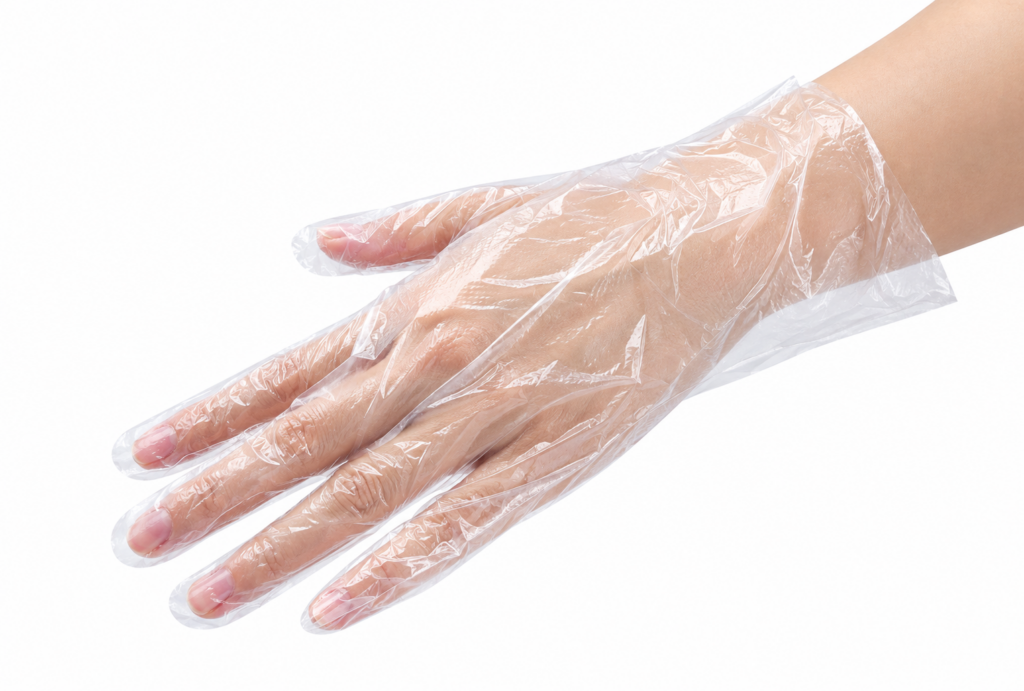
Step 1: Resin peparation
Production begins with incoming resin inspection. Manufacturers check the material specification and supplier documentation, and may verify selected properties according to their quality plan. Resin is stored and handled to reduce contamination and ensure stable feeding into the production line.
Step 2: Film extrusion
HDPE pellets are fed into an extruder, where heat and mechanical action melt the resin. The molten polymer is pushed through a die to form a thin film. Depending on the equipment and product design, the film may be produced as a tube or in another suitable format before being cooled and guided through the line.
Stable extrusion conditions are essential. Temperature, screw speed, output rate and cooling must be controlled to help maintain uniform thickness and avoid defects such as holes, uneven areas or weak spots. These parameters directly affect the consistency and performance of the finished HDPE gloves.
Step 3: Film cooling and winding
After extrusion, the film is cooled and transported through rollers. The line controls tension and alignment as the film is collected into rolls for downstream conversion. Operators monitor the film surface and roll quality to identify visible defects before the material moves to the next stage.
Consistent film quality provides a reliable starting point for producing HDPE gloves with uniform dimensions and fewer defects during conversion.
Step 4: Glove forming and sealing
The film is fed into a glove-making machine, where it is folded or positioned and cut into the required hand shape. Heat sealing joins the film along the glove edges, while cutting separates individual gloves from the surrounding material. The sealing temperature, pressure and dwell time need to be adjusted to the film and machine conditions. Inadequate sealing can lead to open seams, while excessive heat may deform or weaken the film.
Accurate cutting and effective sealing are particularly important for HDPE gloves, as defects along the edges can affect usability and product consistency.
Step 5: Inspection and packing
Finished gloves are checked against the product specification, counted and packed in the required quantity. Packaging should protect the gloves from dust, moisture and handling contamination. Clear batch identification supports traceability if a quality issue needs to be investigated.
3. How is quality controlled?
Quality assurance takes place throughout production, not only at the final inspection stage. For HDPE gloves, a practical quality-control plan may cover:
-Dimensions and thickness: Confirming that glove size and film thickness meet the agreed specification.
-Visual appearance: Checking for holes, contamination, uneven edges, wrinkles and other visible defects.
-Seal integrity: Inspecting sealed edges and checking whether seams remain intact during normal handling.
-Mechanical performance: Testing selected samples for strength or resistance to tearing, where required by the specification.
-Packaging and traceability: Verifying pack quantity, labeling, batch codes and storage conditions.
-Compliance documentation: Reviewing material declarations and relevant food-contact or market-specific requirements when applicable.
Testing methods and acceptance criteria should be defined according to the product specification, intended use and applicable standards. Sampling plans also matter: consistent inspection records help manufacturers identify recurring defects and improve process settings over time.
For manufacturers and distributors, maintaining reliable quality controls helps ensure that HDPE gloves meet agreed requirements across production batches. Buyers should request relevant technical data and compliance documents rather than relying on appearance alone.
4. Partner with Stavian Packaging for quality packaging solutions
At Stavian Packaging, we combine modern manufacturing facilities, advanced production technologies and strict quality control to deliver reliable packaging solutions tailored to diverse customer needs. Our commitment to consistent quality and customized solutions helps businesses optimize packaging performance and build long-term partnerships.
Looking for a reliable packaging partner? Contact Stavian Packaging today to discuss your requirements and explore solutions tailored to your business.
Email: info@stavianpackaging.com
Hotline:+84 24 7306 8868/+84 98 899 2358
Website: https://stavianpackaging.com
Linkedin: https://www.linkedin.com/company/stavian-packaging-vietnam/
